
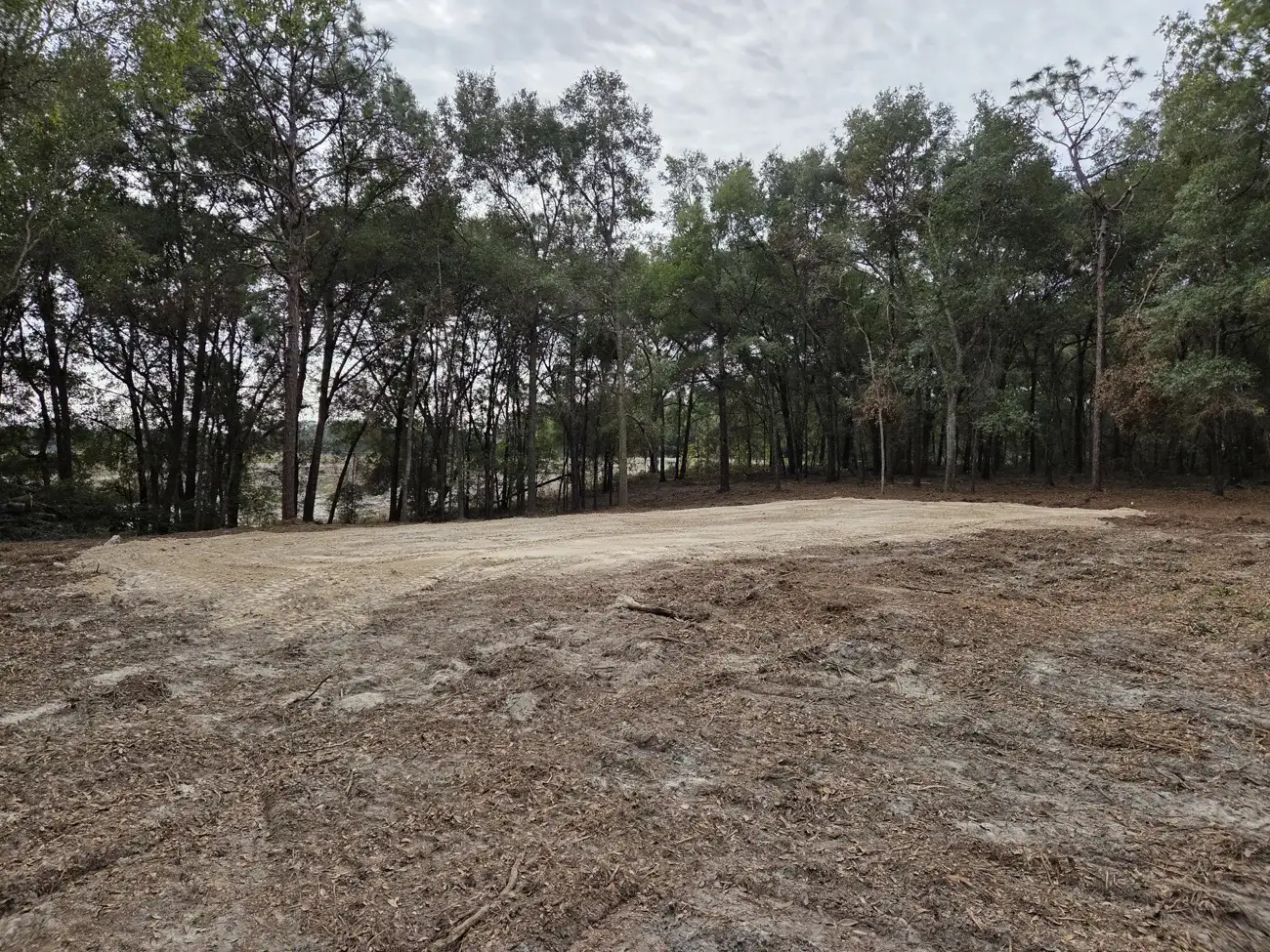
What should you expect when clearing a wooded lot to build in Montgomery County?
Expect a sequence, not a single pass with a machine. A wooded lot becomes a build-ready pad in about eight steps: walk and flag, utility locates, permit and floodplain checks, access, clearing, grubbing the footprint, debris, then grading. Montgomery County adds its own layer with septic siting and floodplain elevation rules. Done in order, the whole thing is routine. Done out of order, it gets expensive. Here is the order.
Here is the sequence at a glance, with who typically owns each step:
| Step | What happens | Owner |
|---|---|---|
| 1. Walk and flag | Footprint staked, keeper trees flagged | You + us |
| 2. 811 locates | Utilities marked, two business days | Us |
| 3. Permits and flood map | County exemption or permit, floodplain check | Us, with you |
| 4. Access and clearing | Route cut, selective clear across the lot | Us |
| 5. Grub the footprint | Stumps and roots out where concrete goes | Us |
| 6. Debris | Mulched in place or hauled off | Us |
| 7. Pad and grading | Select fill compacted, drainage shaped | Us |
| 8. Septic and culvert | County OSSF permit, precinct culvert | You, with our prep |
Before any machine shows up
The first work happens on foot. We walk the lot with you and flag two things: the building footprint, and the trees worth saving. In the Piney Woods that usually means the mature oaks stay, and the sweetgum, volunteer pine, and yaupon thicket go. It is much easier to protect a great tree now than to regret it later; the Texas A&M Forest Service guideline is protective fencing roughly one foot from the trunk for every inch of trunk diameter, with nothing stored, parked, or trenched inside that zone. Compacted soil and cut roots, not chainsaws, are what actually kill trees during construction, and the damage can take years to show.
Second, the paperwork check. Texas law requires an 811 utility locate two business days before digging, weekends excluded, and the wait applies even when you are sure the lot is empty. When a contractor runs the job, the ticket is the contractor’s responsibility, and we pull ours on every job. At the same time we pull the flood map and check the county rules: since October 2025 Montgomery County requires a development permit for clearing unless the job fits a published exemption, and anything in or within 100 feet of the floodplain gets county review. The full breakdown is in our Montgomery County clearing permit guide.
If an old house, barn or slab sits on the lot, our house demolition cost guide for the Houston area covers what a teardown adds to the budget and the permit steps that come before it.
Clearing: selective where you live, complete where you build
With flags up and locates marked, the machines cut access first, then work the lot in two modes.
Across most of the property, selective clearing is the goal. The mulcher grinds the understory and unwanted small trees where they stand and leaves the keepers standing in a park-like woods. The mulch layer stays down as immediate erosion control, which matters on our sandy loams when a Gulf downpour hits a freshly opened site.
The building footprint is different. Under the slab, the driveway, and the utility runs, clearing goes to bare dirt and then below it. Grubbing pulls the stumps and root systems out entirely, because organic material left under concrete rots and settles. Municipal specs in this region call for stumps and roots to come out well below the finished subgrade under anything paved. The stump holes get backfilled and compacted, not just kicked full of loose dirt. Everything outside the footprint can take the cheaper path: grind the stump flush or mulch it, since our stump grinding below grade is plenty for a lawn.
Debris follows the same logic as every job in this county: mulch it in place or haul it. Open-burning land-clearing debris is generally unavailable here, and the schedule should never depend on a burn window.
The Montgomery County layer: septic, floodplain, culvert
Three local checks shape wooded-lot builds here, and all three are cheaper early.
Septic. Outside city sewer, the county requires an on-site sewage facility permit built on a site evaluation with a soil analysis in the exact area the system will go. County minimums run three-quarters of an acre for a septic lot on public water and 1.5 acres with a private well, and the county will not permit a system in a regulatory floodway. The drain field needs to be cleared but not compacted or regraded carelessly, so we plan it alongside the pad rather than after it.
Floodplain. A structure in the 100-year floodplain, or within 100 feet of its boundary, must sit at least two feet above the base flood elevation. On affected lots that number drives the pad design and how much fill the site needs, so it belongs in the first conversation, not the last.
The driveway. A culvert where your drive meets a county road runs through your commissioner precinct, with the pipe set to grade so the ditch keeps draining. It is a small item that stalls a surprising number of builds when nobody owns it.
None of this should scare you off a wooded lot. Montgomery County added tens of thousands of people in a single recent year, one of the fastest-growing counties in the country, and nearly every one of those new homes started as exactly this kind of project.
Grading: where a cleared lot becomes a pad
The last step is the one your foundation lives on. The cleared footprint gets shaped and built up with select fill, placed in compacted lifts and tested to the builder’s or engineer’s spec, with the surface graded so water moves away from the slab in every direction. Flat is not the goal; draining is. Our grading and dirt work crew finishes the pad, and when a site needs more, ponds, trenching, or deeper cuts, the excavation side handles it in the same mobilization.
That is the whole arc: flags, locates, permits, clearing, grubbing, debris, pad. One crew doing the clearing and the dirt work end to end is the difference between a lot that is “cleared” and a lot your builder can start on Monday. Estimates are free at (281) 432-7360, and walking your lot with you is the best first step there is.