
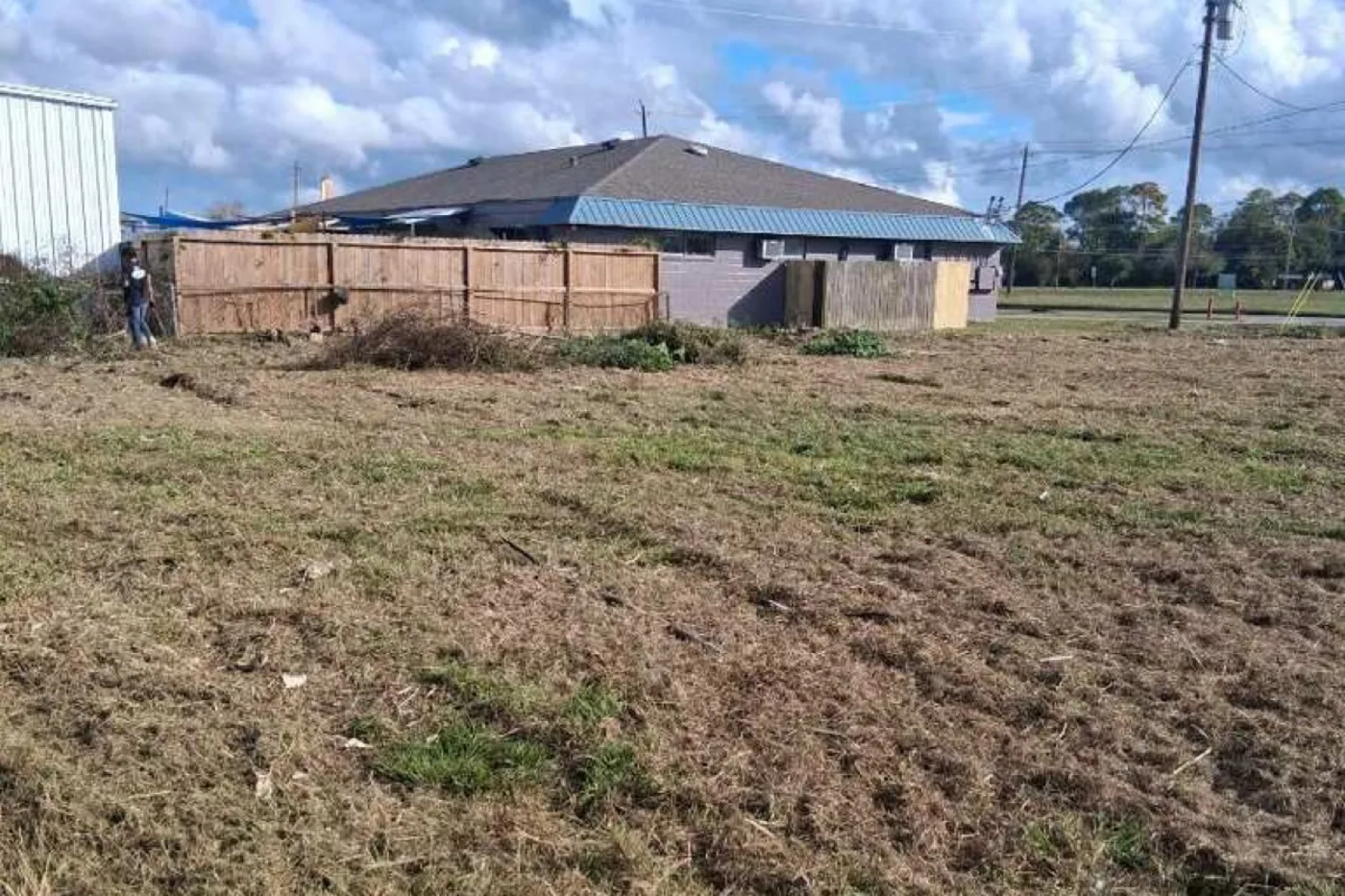
Do you need a permit to clear land in Harris County, TX?
In unincorporated Harris County, the permit trigger is development: any man-made change to improved or unimproved real estate. The county’s list names filling, grading, paving and excavation, but not clearing. So plain clearing with no dirt work or drainage change often needs nothing from the county. Floodplain parcels get checked with the County Engineer’s office first.
The definition says “including but not limited to,” so the list is open-ended. Before any land clearing starts, the MTM Land Clearing Services team checks what the parcel needs. That check is part of the free estimate.
What counts as development in Harris County?
Development is any man-made change to improved or unimproved real estate. The county’s list includes buildings, mining, dredging, filling, grading, paving, excavation, drilling and storing equipment or materials. Fences inside the floodplain count too. Cutting and removing vegetation is not named, but the list says “including but not limited to.”
| Work in unincorporated Harris County | What the County Engineer’s office says |
|---|---|
| Clearing trees and brush | Not named in the definition of development |
| Filling, grading, paving or excavation | Named as development, so a permit is needed |
| Fill outside a special flood hazard area | Residential application, site plan and fill affidavit |
| Fill in a floodway | Not allowed |
| Tearing down a house | No demolition permit; a permit to build afterward |
| Fence inside the floodplain | Counts as development |
The line usually falls where the dirt starts moving. Pulling stumps and root mats leaves holes that get backfilled. Regrading the lot or bringing in fill for a pad puts the job on the named list. In a floodplain, check before any of it.
The county prohibits development in the unincorporated area without first securing a permit. A violation must be removed or permitted. A structure left in violation past the deadline gets a certificate of non-compliance filed in the property records. That filing may prevent a free and clear title.
The county line matters here. Montgomery County next door is different: its definition of development names clearing, as our Montgomery County permit guide explains.
What are the floodplain rules for clearing in Harris County?
Floodplain parcels carry extra rules, so confirm with the County Engineer’s office before any machine work. No fill is allowed in a floodway. In the 100-year floodplain, fill may not be used to raise a structure. Any reduction in 500-year floodplain storage from development or fill must be offset one to one.
The County Engineer’s office is the floodplain administrator for unincorporated Harris County. The Harris County Flood Control District is not one, so permit questions go to the County Engineer. To see where a parcel sits, enter the address in the county’s Information on my Address map.
In the floodplain, a new home’s lowest habitable floor must sit at least 24 inches above the 500-year flood elevation. The other test is 12 inches above the crown of the nearest public street, and whichever is higher applies. Fill cannot raise a structure in the 100-year floodplain. The regulations point to piers or foundation walls with properly sized openings instead.
Outside any special flood hazard area, fill still needs a residential application, a site plan and a fill affidavit. The site plan shows where the fill goes, how much goes in each spot, and how water will flow afterward. Inside a flood hazard area, a registered architect or engineer prepares the mitigation and drainage documents. If your plan includes a building pad, our grading and dirt work page covers shaping it.
Do you need a permit to tear down a house in unincorporated Harris County?
No. The County Engineer’s office says no demolition work permit is required within the unincorporated area of Harris County. A permit is required to construct or develop the property once the demolition is done. So the teardown itself needs no county demolition permit, but building on the lot afterward does.
City limits change the answer. Inside the City of Houston, a demolition permit is required for any residential structure or building. Before applying, a master plumber must pull a plumbing permit and disconnect the sewer and water lines. That work must be inspected and approved first.
Our demolition service takes down houses, mobile homes and outbuildings, then grades the spot. Slab, foundation and driveway removal are part of that scope too.
When does a big clearing job need a state stormwater permit?
When the clearing is part of a construction project that disturbs one acre or more of soil. TCEQ’s construction stormwater general permit, TXR150000, covers those projects. Sites from 1 to under 5 acres count as small construction, and 5 acres or more is large. Both fall under the same general permit.
The threshold looks at the whole plan. A small lot can still be covered when it belongs to a larger common plan of development or sale. Projects under an acre that are not part of a bigger plan fall outside the permit. If the clear starts a build, our site preparation page covers the next steps.
Do you need to call 811 before clearing land?
Yes, before any digging. Texas law requires a call to 811 two business days before digging, even in your own backyard. Weekends and holidays do not count, and pulling stumps or trenching counts as digging. The call is free, and when a contractor does the digging, placing it is the contractor’s responsibility.
After the wait, digging starts once every notified utility has marked the area or reported it clear. If you want proof the call went in, ask for the ticket number.
What changes inside Houston or another city?
The county rules above stop at city limits. Harris County has 34 floodplain administrators: the County Engineer’s office covers unincorporated land, and incorporated cities run their own programs. Inside a city such as Houston, Tomball or Humble, the city’s permit office sets the rules. Check jurisdiction before anything else.
Inside Houston, a permit is required to remove any tree on city property or on a setback. City property includes rights of way, medians and parks. For trees on private property, the city tells owners to contact an arborist or tree service. City rights of way are the exception.
Before clearing a wooded city lot, find out whether any tree stands in a right of way or setback. Our page on land clearing in Houston covers the soils and ground conditions there. Tomball and Humble are incorporated cities too. Our Humble land clearing page covers the rules inside Humble’s city limits.
For site work, unincorporated land stays with the county, even inside Houston’s extraterritorial jurisdiction. That includes land clearing in Cypress: the community is unincorporated and sits entirely inside that zone. Atascocita and Crosby are unincorporated too, and our Crosby land clearing page covers the county steps there.
Can you burn the brush after clearing land in Harris County?
Only in narrow cases. Outdoor burning is generally prohibited in Texas, and Harris County is a designated ozone nonattainment county. There, plant debris from land clearing can be burned only when no practical alternative exists. TCEQ lists mechanical chipping or mulching as a possible alternative, so plan on mulching or hauling.
TCEQ defines a practical alternative as one that is economically, technologically, ecologically and logistically viable. Any burn that does qualify must happen at the site of the land clearing. You may not move the material to burn it elsewhere, even onto land you own. Inside city limits in a nonattainment county, this burning is not exempt unless the city has an ordinance allowing it.
Burn bans stack on top. During extreme fire danger, a county judge and commissioners court may ban outdoor burning in the unincorporated county. TCEQ does not issue or regulate those bans.
Grinding debris where it stands is what our forestry mulching service does. Whatever cannot stay on site gets hauled off, so the schedule does not hang on a burn window.
What does MTM check before a Harris County clearing job?
The team checks what the parcel needs during the free estimate. That starts with jurisdiction: inside a city, or in the unincorporated county. Next come the flood map and any plan to grade, fill or build a pad. Anything that points toward a permit gets flagged so the owner can confirm it with the right office.
Clearing and grubbing is standard scope for our land clearing services around Houston. That means trees and brush down, with stumps and root mats pulled. Debris is mulched on site or hauled off, the owner’s choice.
MTM clears lots and acreage around Spring, north Houston and the Harris County towns nearby, and every estimate is free. Call (281) 432-7360 or request a free estimate.